Knowledge Sprints | 24–25 June 2026 | Amsterdam-Schiphol
Growing Maintenance Services: From Better to More Value
Advanced maintenance is proven, but it only creates value where it fits. Push predictive everywhere and you spend money where it won't earn a return.
The bigger opportunity comes from treating maintenance as a system for creating value, not a cost to control: a wider set of services, a more strategic position, and a clear line through to how that value is priced.
This Sprint works through both halves.
Who
Service strategy, service product management, maintenance and asset management, commercial, and customer value proposition roles, at B2B manufacturers of complex industrial equipment.
Group shape
Cross-functional, small tables of six. Members often bring one or two colleagues from different functions so the learning carries back into the team. Colleagues are distributed across tables, never seated together, so each table holds cross-company peer mix.
Format
Four short online sessions in the weeks before, two days in-person, then a follow-up session three months after.
When does advancing maintenance actually create value, and what wider service opportunity opens once maintenance becomes a system for creating value rather than a cost to control?
Most conversations about advanced maintenance start with the technology: connected assets, predictive models, prescriptive analytics. This Sprint starts a step earlier. When does advancing maintenance actually create value, and when is it spending money where it won't earn a return? Predictive and prescriptive maintenance are proven, but they only pay where they fit. For many assets, preventive or condition-based maintenance is enough; for some, running to failure is the right economic call. The useful question is which of the customer's value drivers matter most: uptime and throughput, maintenance cost, the capital tied up in the asset, or safety and compliance, and which maintenance approach actually moves them. And even where prediction is justified, the value is only realised when the insight becomes work that gets executed. That is where most programmes stall.
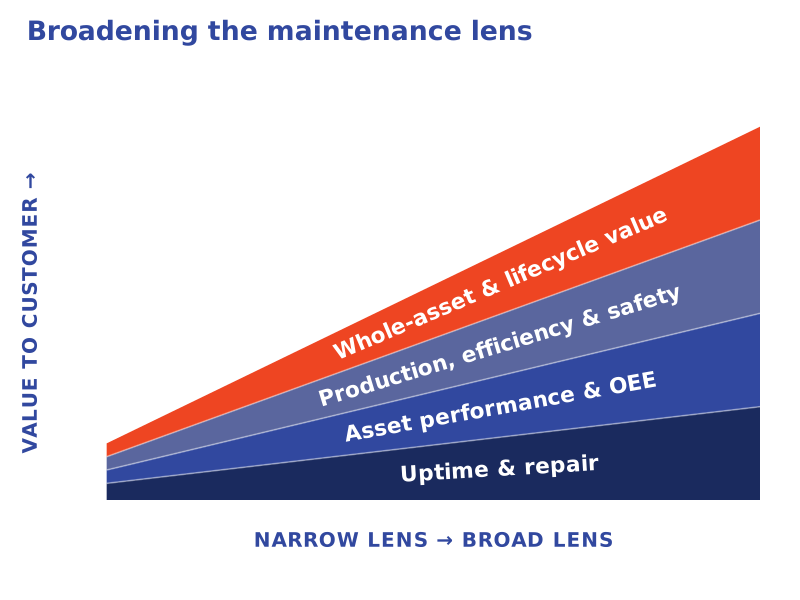
That reframing opens a far wider field. Once maintenance is treated as a system for creating value rather than a cost to control, a broader set of jobs comes into view: deciding which assets matter and what each one needs, turning condition insight into executed work, and owning the strategy and governance layer above day-to-day operations. That is where the value is decided, where customers struggle most, and where competition is thinnest. This is a portfolio of services well beyond prediction, delivered the way the customer prefers: do-it-yourself, do-it-with-me, or do-it-for-me, and carried through to how the value is priced and captured.
This Sprint works across the parts of the Service Transformation Framework most relevant to the question: innovation and growth in winning service strategies, innovation and revenue generation in service business models, and the always-on base of a resilient, learning organisation.
The Sprint works through questions like these:
The four value drivers.
Uptime and throughput, maintenance cost, capital and asset life, safety and compliance, and which of these dominates by asset, lifecycle stage, and business context.
The right approach per failure mode.
When preventive or condition-based maintenance is enough, when predictive or prescriptive genuinely pays, and when running to failure is the right call.
Why predictive isn't the growth engine on its own.
Its natural ceiling and readiness dependency, and the hardest jump of all, turning condition insight into executed work.
The wider maintenance jobs-to-be-done.
Where customers lose value today, and the opportunities that open once maintenance is treated as a value system.
The strategy-and-governance position.
Operating above day-to-day execution, where the value at stake is greatest and competition thinnest, across do-it-yourself, do-it-with-me, and do-it-for-me models.
Monetisation.
How to price and capture the value created, matching revenue and commercial models to customer maturity and the value at stake.
What's included
Four online prep sessions, aligned scope and surfaced real cases before the deep-dive.
Two days in Amsterdam at a small table of six, cases worked through across service strategy, maintenance, commercial, and value proposition roles.
A follow-up session three months after to review what had been applied and what was getting stuck.
Access to the relevant Service Transformation Playbooks with frameworks and case material behind the Sprint. Access continues for participants after the Sprint.
Bring your colleagues
Decisions on data-enabled maintenance services sit across service strategy, commercial, and maintenance operations. Bringing colleagues from each means the work travels back to the team, not one person.
| Participants | Price non-members |
|---|---|
|
1 participant
|
€2.500
|
|
2 participants |
€4.500
|
|
3 participants
|
€6.000
|
Colleagues from the same organisation are distributed across different tables, never seated together, so each carries cross-company peer mix back into the team.
What you leave with
A clearer read on where advancing maintenance actually creates value: which value drivers matter, and which maintenance approach moves them, by asset and context.
A view of where predictive and prescriptive pay, and where they don't: including the hardest jump, turning condition insight into executed work.
A map of the wider service opportunity: the maintenance jobs beyond prediction, the strategy-and-governance position, and the DIY / DIWM / DIFM choice, ready to take back to the cross-functional team you brought.
A working line from value to monetisation: how to price and capture the value created, matched to customer maturity.
A small circle of peers working the same shift from better maintenance to more value: people you can call when the next version of the problem lands.
Continued access to the relevant Service Transformation Playbook sections: a reference base for ongoing work after the deep-dive.
See where your advanced-service monetisation stands
The Monetising Advanced Services Study is an independent research programme with senior leaders at B2B manufacturers on what makes advanced-service revenue grow, and what makes it stall.
Take part in a 60-minute executive conversation, with no pre-questionnaire, and get an individual diagnostic you can share with your leadership team.
What participants say
The smaller setting allows for much more focused and in-depth conversations. In this Service Transformation Summit, we go deep on a specific topic, I think it's beneficial, especially knowing that there will be other summits to cover other topics.
Navè Orgad
Director, Business Development & Customer Experience, Konecranes
We got a lot of ideas, a lot of good examples. Some of them we can implement immediately. Some others we have to think about and see how it will work for us. This Summit has given us a kind of a long list of opportunities.
Olivier Cocheril
Vice-President Asset Performance & Maintenance Solutions, Sidel
It is very interesting to discuss with your peers and also learn from each other how to break through the barriers and challenges. The Service Transformation Summit is really practitioners-only. So there are no vendors around trying to sell me. The big benefit is that you can be much more open up compared to some other events, without ending up in a marketing funnel.