Knowledge Sprints
A closed peer working session for service leaders at B2B manufacturers, two in-person days on one real service transformation question, together in the same room.
Who
Global and regional service leaders, service development leaders, service innovators, and service marketing & sales leads at B2B manufacturers of machinery, heavy equipment, industrial automation, and high-precision instruments.
Group shape
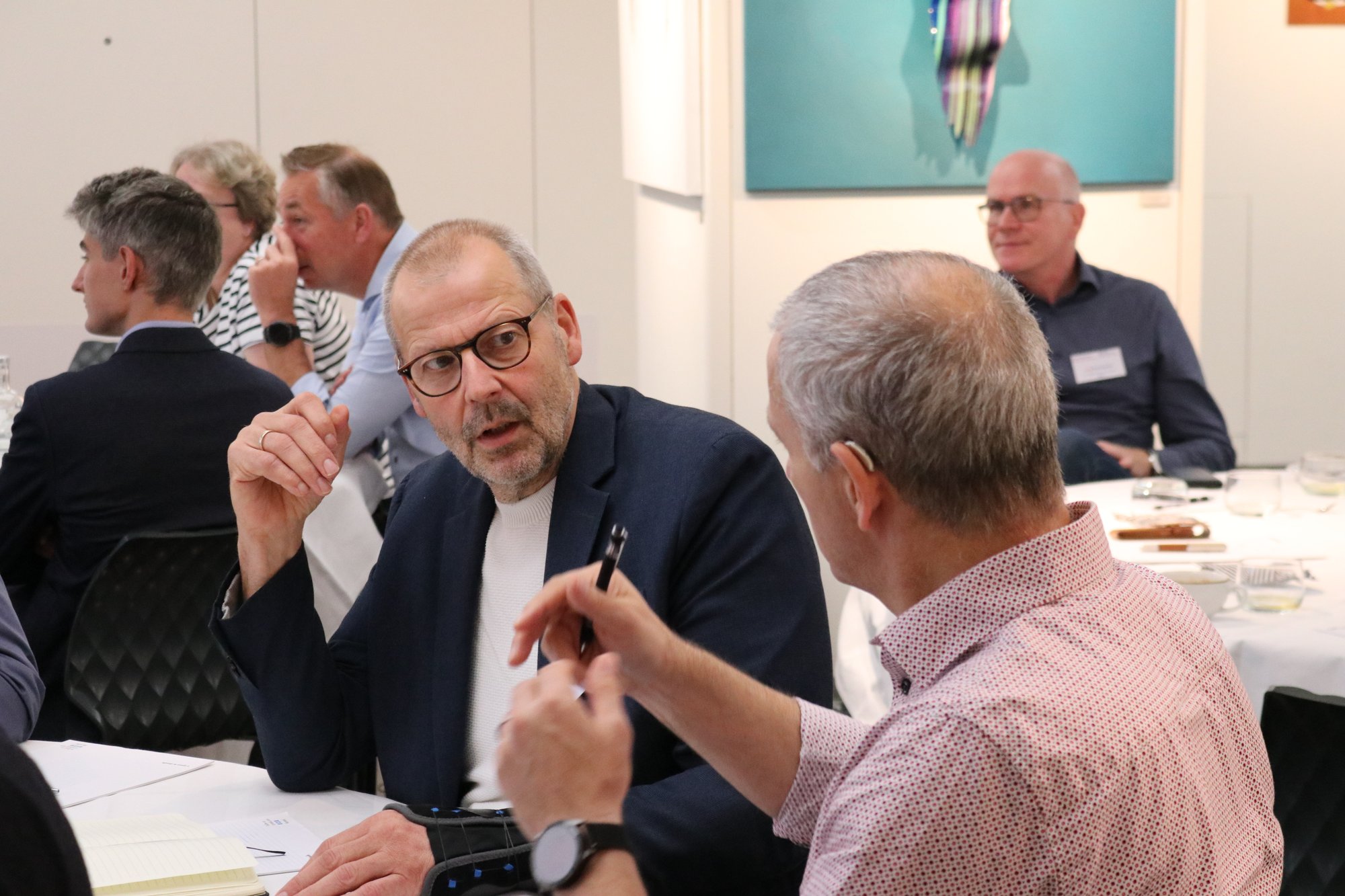
Cross-functional, small tables of six. Members often bring one or two colleagues from different functions so the learning carries back into the team.
Colleagues are distributed across tables, never seated together, so each table holds cross-company peer mix.
Format
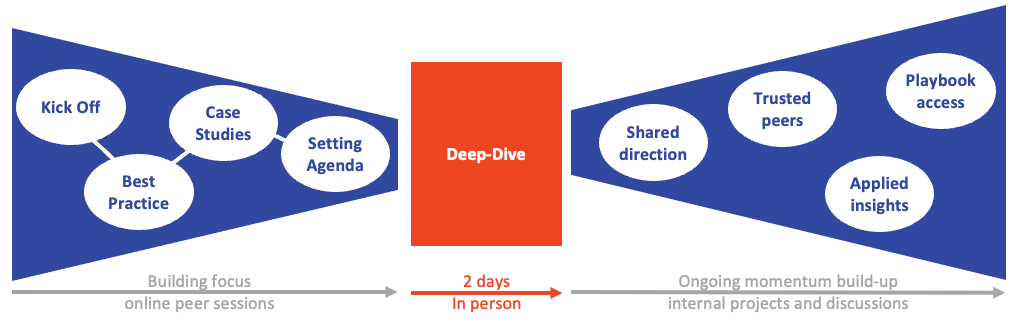
Four short online sessions in the weeks before, two days in-person, then a follow-up session three months after.
Next Deep-Dive
Sprint 1 — 24–25 June 2026 · Amsterdam
Topic: data-enabled maintenance services
Cadence
Three Sprints a year; members often participate in successive Sprints as priorities shift.
Topics set annually by the moreMomentum member panel.
Investment
From €2,500 per participant.
A Sprint is not a conference., masterclass., roundtable., training program.
Why we run Sprints
There's no shortage of content on service transformation. Conferences, research, frameworks, publications. What's scarce is knowledge structured for the people actually making the decisions.
We see the gap in three places.
Noise
Much of what's published is too generic to apply, too academic to translate, or biased by whoever paid for it. That doesn't leave executives with nothing. It leaves them with too much of the wrong thing. Which framework holds up in your context is a judgement call, and today it sits with whoever the reader already trusted.
Knowing vs doing
A framework explains the pattern. It rarely explains the choices. How did the other team handle pushback from sales? What got cut when the budget tightened? Where did the plan bend? Those answers live with peers who've run the same programme, not in the framework itself.
Foresight
New dynamics in service move faster than the evidence base. AI in diagnostics, outcome-based contracts, data shared across the value chain: by the time the best-practice paper is written, the question has shifted. Executives need structured thinking about what's emerging, not just validated answers about what already worked.
How Sprints close the gap
A Sprint tightens around one strategic question over three months. Members get the curated reference knowledge — frameworks, benchmarks, cases — cleared of the noise. Then they work through it with peers running the same question in their own organisations. The output isn't a report. It's a clearer point of view on a decision you're already facing.
We run Sprints on questions sitting ahead of the evidence. Where the framework doesn't yet exist, the cases are still unfolding, or the right answer depends on judgement that only emerges when the right people think it through together.
How a Knowledge Sprint works
Two mechanisms do the work.
Shared base, built upfront.
Short online sessions in the weeks before the deep-dive transfer foundational knowledge (drawing on the Service Transformation Playbooks), set scope, and surface each member's live questions.
The group covers general ground together, upfront — so the two in-person days are preserved for what only close peer work can do.
Real cases, worked on together.
The deep-dive takes apart the challenges participants actually face. Cases are tested against lived experience.
The knowledge, know-how, and foresight that emerge travel back into members' teams as work, not as slides.
Upcoming Sprints
Growing Data-Enabled Maintenance Services amid Customer Pushback
Predictive maintenance often stalls when customers resist connectivity or prefer to keep maintenance in-house.
How to find and pursue the growth opportunity with advanced, data-anabled maintenance services.
Deep-dive: 24-25 June 2026
Amsterdam - Schiphol
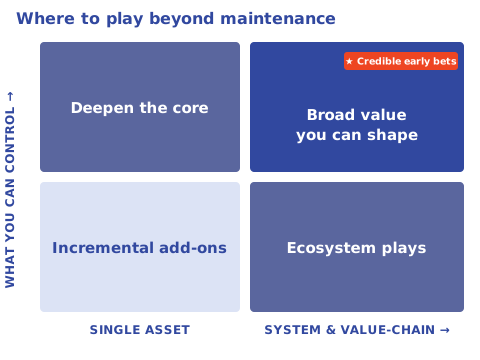
Building Emerging Digital Services Beyond Maintenance
The opportunity beyond maintenance is real. So is the uncertainty. How to launch credible early-stage services — before the business model is clear.
Deep-dive: 10–11 November 2026
Amsterdam - Schiphol
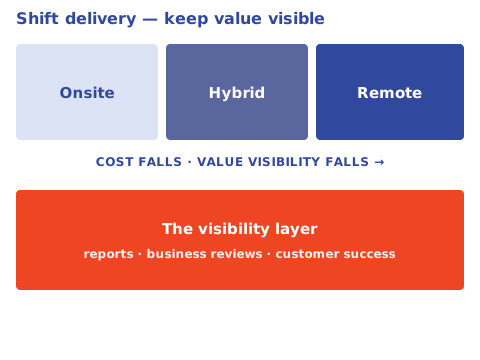
Reducing Onsite Service Delivery Without Eroding Service Value
Rising field costs push remote delivery. But physical presence is often what makes service value visible. How far can you go — and under what conditions?
Deep-dive: 9–10 December 2026
Amsterdam - Schiphol
What’s included
|
Four online prep sessions to build a shared base with the group before the deep-dive.
|
|
Two in-person days at a small table of six where your real case is worked through with peers running the same question.
|
|
A follow-up session three months after to catch what has been applied and what is getting stuck.
|
|
Access to the relevant Service Transformation Playbooks with frameworks, benchmarks, and case material drawn from years of direct work with B2B manufacturers. Access continues for participants after the Sprint, not time-limited to the Sprint window.
|
|
A curated cross-functional table with peers chosen for topic relevance and composed to avoid direct competition.
|
Bring your colleagues
The decisions a Knowledge Sprint works through rarely sit with one role.
Bringing two or three colleagues from different functions means the shared language travels back to a team that already holds the problem.
| Participants | Price non-members |
|---|---|
|
1 participant
|
€2.500
|
|
2 participants
|
€4.000
|
|
3 participants
|
€5.000
|
Colleagues from the same organisation are distributed across different tables, never seated together, so each carries cross-company peer mix back into the team.
What you leave with
|
A clearer position on the question you came with tested against peers running the same question in their own organisations, so the direction you take back is one you've already stress-tested.
|
|
A working plan for what to put in motion, scope, sequence, and who needs to be involved back in your organisation.
|
|
A shared language for the question across the colleagues you brought, so the decision carries back into the team rather than staying with one person.
|
|
A small circle of service peers you can keep drawing on, people you can call when the next version of the problem lands.
|
|
Continued momentum between Sprints: Playbook access and the option to join successive Sprints as priorities shift, so the strategic muscle compounds rather than resets.
|
What participants say
The smaller setting allows for much more focused and in-depth conversations. In this Service Transformation Summit, we go deep on a specific topic, I think it's beneficial, especially knowing that there will be other summits to cover other topics.
Navè Orgad
Director, Business Development & Customer Experience, Konecranes
We got a lot of ideas, a lot of good examples. Some of them we can implement immediately. Some others we have to think about and see how it will work for us. This Summit has given us a kind of a long list of opportunities.
Olivier Cocheril
Vice-President Asset Performance & Maintenance Solutions, Sidel
It is very interesting to discuss with your peers and also learn from each other how to break through the barriers and challenges. The Service Transformation Summit is really practitioners-only. So there are no vendors around trying to sell me. The big benefit is that you can be much more open up compared to some other events, without ending up in a marketing funnel.
Vincent Sieben
Head of Marketing Services & Solutions, Philips
See where your advanced-service monetisation stands
The Monetising Advanced Services Study is an independent research programme with senior leaders at B2B manufacturers on what makes advanced-service revenue grow, and what makes it stall.
Take part in a 60-minute executive conversation, with no pre-questionnaire, and get an individual diagnostic you can share with your leadership team.
Past peer events
|
A clearer position on the question you came with tested against peers running the same question in their own organisations, so the direction you take back is one you've already stress-tested.
|
|
A working plan for what to put in motion, scope, sequence, and who needs to be involved back in your organisation.
|
|
A shared language for the question across the colleagues you brought, so the decision carries back into the team rather than staying with one person.
|
|
A small circle of service peers you can keep drawing on, people you can call when the next version of the problem lands.
|
|
Continued momentum between Sprints: Playbook access and the option to join successive Sprints as priorities shift, so the strategic muscle compounds rather than resets.
|