
Knowledge Sprints | 14–15 April 2026 | Amsterdam
Growing Data-Enabled Maintenance Services amid Customer Pushback
Progress in data-enabled maintenance rarely stalls because the technology isn’t ready. It stalls because customers don’t see the value, resist connectivity, or prefer to keep maintenance capabilities in-house. This Sprint worked through how to change that — from the customer’s maintenance logic, not the provider’s technology case.
Who
Service strategy, service product management, maintenance and asset management, commercial, and customer value proposition roles — from B2B manufacturers of complex industrial equipment.Group shape
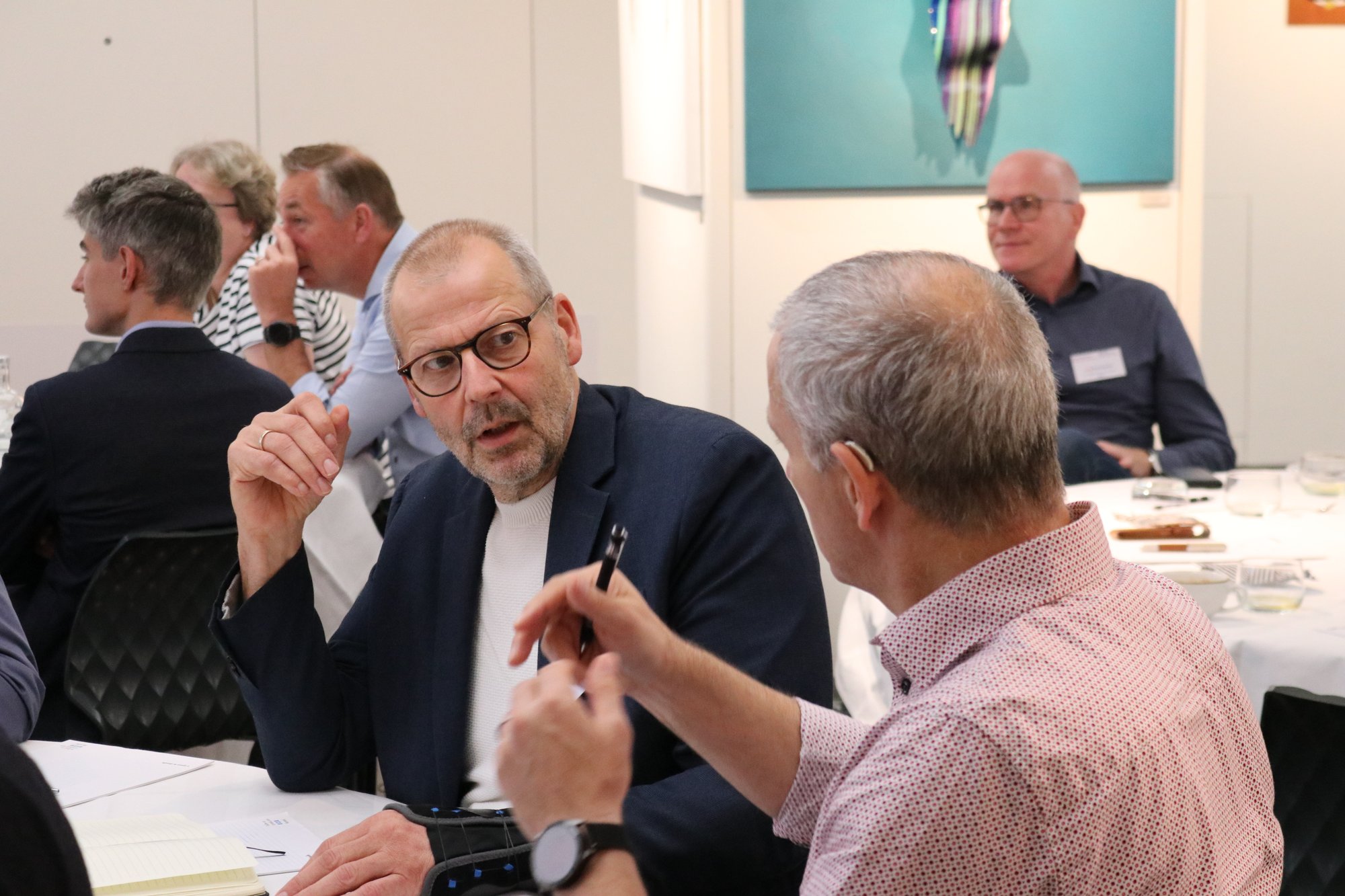
Cross-functional, small tables of six. Members often bring one or two colleagues from different functions so the learning carries back into the team. Colleagues are distributed across tables — never seated together — so each table holds cross-company peer mix.
Format
Four short online sessions in the weeks before, two days in-person, then a follow-up session three months after.
Industries: Machinery, heavy equipment, industrial automation, medical devices, automotive, high-precision instruments.
Core-question
How do we grow data-enabled maintenance services when customers resist connectivity, don't automatically see value, and prefer to keep maintenance capabilities in-house?
Many service organisations worked toward more proactive, condition-based, and predictive maintenance models. The progress was rarely limited by the technology — connected assets generated the data, remote monitoring was feasible, the technical case held. What held progress back was something harder: customers didn't always see the value, resisted connectivity, or preferred to keep maintenance capabilities in-house.
The variation mattered. Maintenance value differed strongly by industry, asset type, and customer context. Customers differed in what they wanted to keep in-house, co-manage, or outsource. Solutions designed around technical sophistication rather than customer value logic consistently missed — not because they weren't clever, but because they answered the wrong question.
This Sprint worked across the parts of the Service Transformation Framework most relevant to the question — innovation and growth in winning service strategies, innovation and revenue generation in service business models, and the always-on base of a resilient, learning organisation.
Sub-questions
|
Jobs-to-be-Done in advanced maintenance. Where the real growth opportunities actually sit, starting from customer maintenance logic rather than technology assumptions. |
|
Preventive versus predictive. When preventive maintenance is sufficient and when predictive is genuinely better, and for which customer contexts. |
|
Maintenance value by asset type and industry. How the economic case shifts across mission-critical equipment, bulk assets, and mixed installed bases. |
|
DIY, DIWM, and DIFM preferences. How customer preferences for doing it themselves, co-managing, or fully outsourcing shape viable service propositions. |
|
The trust and willingness-to-pay gap. Why more data does not automatically lead to trust or willingness to pay, and what closes that gap. |
What's included
|
Four online prep sessions, aligned scope and surfaced real cases before the deep-dive.
|
|
Two days in Amsterdam at a small table of six, cases worked through across service strategy, maintenance, commercial, and value proposition roles.
|
|
A follow-up session three months after to review what had been applied and what was getting stuck.
|
|
Access to the relevant Service Transformation Playbooks with frameworks and case material behind the Sprint. Access continues for participants after the Sprint.
|
|
A curated cross-functional table with peers chosen for topic relevance and composed to avoid direct competition.
|
What you leave with
|
Sharper thinking on where maintenance value actually sits for customers. Tested against peers working the same question across different asset types and industries.
|
|
A working view of the preventive-versus-predictive choice by context applicable to the next wave of service product decisions.
|
|
Concrete approaches to DIY / DIWM / DIFM boundaries that travel back into teams through the colleagues who participated, distributed across functions.
|
|
A small circle of peers navigating customer pushback on connectivity, a group that continues beyond the Sprint.
|
|
Continued access to the relevant Playbook sections; a depth of reference for ongoing work after the deep-dive.
|
Investment
Approximately 3 days per participant, per Sprint in 2-3 months:
- 4 short online sessions in the weeks leading up to the deep-dive - 1.5 to 2 hours each)
- Kick-Off
- Discuss Best Practices
- Discuss Case Studies,
- Set the Deep-Dive Agenda
- 2-day in-person deep-dive in Amsterdam.
- Optional pre-reading and diagnostic assessment
| Participants | Price non-members | Price members |
|---|---|---|
|
1 participant
|
€2.500
|
Included*
|
|
2 participants |
€4.000
|
Included*
|
|
3 participants
|
€5.000
|
Included*
|
*) Members receive a set number of seats per organisation.
Includes lunch, dinner, and refreshments during the in-person meeting. Excludes VAT and hotel accommodation.
Questions about which Sprint fits your team?
Benchmark your service business
The Service Growth Study — independent diagnostic on where service transformation stands across the industry, and where your business sits against peers. Useful alongside a Sprint, or on its own.
What participants say

The smaller setting allows for much more focused and in-depth conversations. In this Service Transformation Summit, we go deep on a specific topic, I think it's beneficial, especially knowing that there will be other summits to cover other topics.
Navè Orgad
Director, Business Development & Customer Experience, Konecranes

We got a lot of ideas, a lot of good examples. Some of them we can implement immediately. Some others we have to think about and see how it will work for us. This Summit has given us a kind of a long list of opportunities.
Olivier Cocheril
Vice-President Asset Performance & Maintenance Solutions, Sidel
It is very interesting to discuss with your peers and also learn from each other how to break through the barriers and challenges. The Service Transformation Summit is really practitioners-only. So there are no vendors around trying to sell me. The big benefit is that you can be much more open up compared to some other events, without ending up in a marketing funnel.