Knowledge Sprints | 9-10 December 2026 | Amsterdam-Schiphol
Reducing Onsite Service Delivery Without Eroding Service Value
Rising field service costs, scarce experienced engineers, and better remote capabilities are pushing service organisations to reduce onsite delivery.
But shifting work away from the field changes how customers see service value, how responsibility sits, and how pricing power holds up.
This Sprint works through how far you can go, and under what conditions.
Who
Service delivery and operations leaders, service design and portfolio managers, commercial and pricing leads, customer experience and trust leaders, strategy and change professionals, from B2B manufacturers with significant field-service footprints.
Group shape
Cross-functional, small tables of six. Members often bring one or two colleagues from different functions so the learning carries back into the team. Colleagues are distributed across tables, never seated together, so each table holds cross-company peer mix.
Format
Four short online sessions in the weeks before, two days in-person, then a follow-up session three months after.
How far can onsite service delivery be reduced, and under which conditions, without eroding service value?
Across industrial service organisations, the case for reducing reliance on onsite field service is building. Field service costs are rising. Experienced engineers willing to travel are harder to find. Remote diagnostics, guided execution, and virtual expert support are increasingly feasible. In some contexts, faster remote response already outperforms onsite dispatch.
But shifting work away from the field is not a technical problem. It changes how customers see service value, how responsibility and accountability sit between provider and customer, and how pricing power and differentiation work. Done without thinking it through, it erodes exactly what made the service worth buying.
The variation matters. In some environments, non-onsite delivery can meaningfully replace onsite execution without undermining outcomes. In others, particularly where safety, regulatory compliance, or outcome accountability are critical, it can only complement, not replace, field service. Customers differ too, in how much responsibility and execution they're willing or able to take on.
The Sprint works through questions like these:
Substitute versus complement.
The conditions that determine when non-onsite delivery can genuinely substitute onsite execution, and when it can only complement it.
Responsibility and accountability across DIY, DIWM, and DIFM.
How service work is distributed between provider, customer, and third parties. Where reducing onsite execution requires rethinking scope and boundaries.
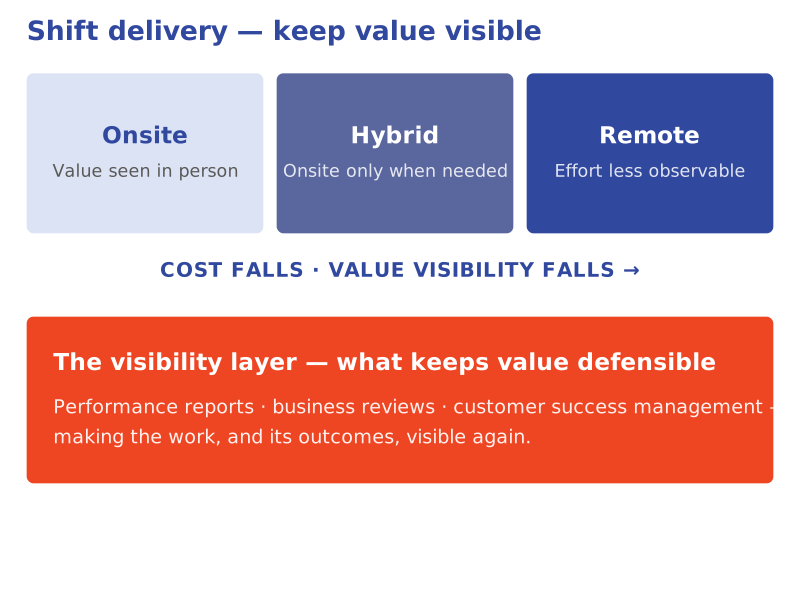
Keeping service value visible when physical presence is reduced.
How customers define value when the engineer is no longer on site. How to make value defensible when effort is less observable.
Pricing and margin logic when execution and enablement separate.
How reduced onsite effort affects willingness to pay. Which pricing models reinforce value rather than accelerate erosion.
The traps to avoid.
Treating non-onsite delivery as a cost-reduction initiative without redesigning the value proposition. Shifting execution responsibility without making accountability explicit.
What's included
Four online prep sessions: to build shared context on where onsite reduction is already working and where it is breaking.
Two in-person days at a small table of six: your real decision worked through with peers operating under the same pressure.
A follow-up session three months after: to catch what has shifted and where value or pricing is showing strain.
Partial access to the Service Transformation Playbooks library: frameworks and case material on service delivery, pricing, and customer value, drawn from years of direct work with B2B manufacturers. Access continues for participants after the Sprint.
Bring your colleagues
Reducing onsite service delivery touches operations, commercial, customer experience, and pricing at once. Bringing colleagues from across the affected functions means the trade-offs are owned by the team, not one person.
| Participants | Price non-members |
|---|---|
|
1 participant
|
€2.500
|
|
2 participants |
€4.500
|
|
3 participants
|
€6.000
|
Colleagues from the same organisation are distributed across different tables, never seated together, so each carries cross-company peer mix back into the team.
What you leave with
A clearer read on where non-onsite delivery can substitute and where it can only complement: tested across peers with different asset types and customer contexts.
A working view of how service value holds up when physical presence reduces: what customers actually pay for when the engineer is no longer on site, ready to take to the cross-functional team you brought.
A sharper pricing logic for the shift: which models reinforce value rather than accelerate erosion.
A small circle of peers navigating the same trade-off: people you can draw on when the next decision point lands.
Continued access to the relevant Service Transformation Playbook sections: a reference base for ongoing work on the delivery model.
See where your advanced-service monetisation stands
The Monetising Advanced Services Study is an independent research programme with senior leaders at B2B manufacturers on what makes advanced-service revenue grow, and what makes it stall.
Take part in a 60-minute executive conversation, with no pre-questionnaire, and get an individual diagnostic you can share with your leadership team.
What participants say
The smaller setting allows for much more focused and in-depth conversations. In this Service Transformation Summit, we go deep on a specific topic, I think it's beneficial, especially knowing that there will be other summits to cover other topics.
Navè Orgad
Director, Business Development & Customer Experience, Konecranes
We got a lot of ideas, a lot of good examples. Some of them we can implement immediately. Some others we have to think about and see how it will work for us. This Summit has given us a kind of a long list of opportunities.
Olivier Cocheril
Vice-President Asset Performance & Maintenance Solutions, Sidel
It is very interesting to discuss with your peers and also learn from each other how to break through the barriers and challenges. The Service Transformation Summit is really practitioners-only. So there are no vendors around trying to sell me. The big benefit is that you can be much more open up compared to some other events, without ending up in a marketing funnel.